






Lasagna on the Limit: Mastering the Advanced Drifting Mechanics of Garfield Kart 2 - All You Can Drift
Garfield Kart 2 - All You Can Drift is far more than a simple licensed racer; it is a high-octane mechanical simulation that demands precise timing, topographical awareness, and a deep understanding of the "Lasagna Friction" engine. While its predecessor laid the groundwork for casual karting, the sequel introduces a complex "All You Can Drift" system that rewards players for maintaining extended slides across variable terrain. To achieve the coveted Platinum Lasagna Trophy, a racer must look past the colorful aesthetic and engage with the game’s deep technical architecture, specifically its unique approach to rotational momentum and turbo-tiering.
This article serves as a comprehensive technical breakdown of how to master the drifting meta within the game. We will explore the mathematical relationship between drift angle and heat accumulation, the environmental variables of the "Jon’s House" and "Pooky’s Playpen" circuits, and the strategic deployment of the "Nermal Shunt." Mastering this game requires a shift from standard racing lines to a continuous-slide philosophy where the brake pedal is used more for steering than for slowing down. Prepare to dive into the technical depths of a world where speed is orange and the only sin is driving in a straight line.
1. The Anatomy of the Drift: Understanding the Slide Initiation Phase
Success in Garfield Kart 2 starts at the entry point of every corner. The game utilizes a "Jump-to-Slide" mechanic where pressing the shoulder button initiates a hop that breaks static friction. The duration of this hop is critical; if you hold the button too long before touching the ground, you lose downward force, resulting in a "Floaty Entry" that kills your speed. The goal is to time the hop so that your tires hit the asphalt exactly as your kart’s nose is pointed toward the apex. This sets the initial "Angle of Attack," which determines how much turbo energy you can harvest during the turn.
Once the slide is initiated, the game’s physics engine begins calculating your "Drift Radius." Unlike other kart racers where you have a fixed turning arc, Garfield Kart 2 allows for "Counter-Steer Pumping." By rapidly flicking the joystick in the opposite direction of the turn, you can widen your arc without breaking the drift, allowing you to navigate wide sweepers while building up a Tier 3 "Garfield Glow" turbo. Mastering this initial phase is the difference between a clumsy bump against the guardrail and a perfect, energy-generating slide.
2. Thermal Dynamics: Managing the Sizzle Gauge for Maximum Boost
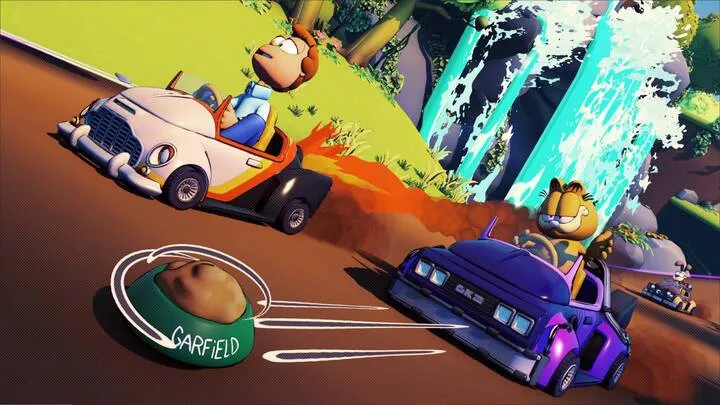
One of the most innovative features in All You Can Drift is the "Sizzle Gauge," a visual representation of the heat generated by your tires during a slide. As you maintain a drift, the gauge fills from blue to orange, and finally to a flashing "Lasagna Red." If you release the drift while the gauge is red, you receive a "Crispy Boost," which offers 150% more duration than a standard blue boost. However, if you hold the drift too long, your tires will "Burn Out," resulting in a temporary speed penalty and a loss of all accumulated energy.
Managing this gauge requires a high degree of "Micro-Drifting." On straightaways, elite players will perform short, zigzagging drifts to keep the Sizzle Gauge at a baseline temperature without triggering a burnout. This ensures that the moment they enter a real corner, they are already halfway to a Red Boost. This constant thermal management creates a high-intensity gameplay loop where the player is perpetually sliding, even when the track is straight.
The Boost Tier Hierarchy
- Tier 1 (Blue Spark): 0.5 seconds of 10% speed increase. Generated after 1 second of drifting.
- Tier 2 (Orange Flame): 1.2 seconds of 25% speed increase. Generated after 2.5 seconds.
- Tier 3 (Lasagna Red): 2.5 seconds of 45% speed increase. Requires a continuous drift of 4 seconds or more.
3. Topographical Drifting: Navigating Verticality and Gravity Wells
The tracks in Garfield Kart 2 are not flat planes; they are filled with "Gravity Wells" and "Reverse Camber" turns. When drifting uphill, your "Drift Decay" increases, meaning you lose speed much faster if you don't maintain a sharp angle. Conversely, drifting downhill allows for "Gravity-Assisted Slides," where the game’s engine reduces tire friction, allowing for nearly infinite drifts. Understanding the "Apex Elevation" of a track like "The Italian Alps" is vital for choosing whether to initiate a drift early or late.
Furthermore, jumping off a ramp during a drift allows you to perform a "Mid-Air Correction." By tilting the joystick while airborne, you can change the orientation of your kart so that when you land, you immediately resume the drift in the opposite direction. This "S-Link" technique is essential for the complex chicane sections of the later cups. If you land with your wheels straight, you lose all your built-up Sizzle, but landing at an angle allows the momentum to carry over, creating a "Perpetual Slide" state.
4. The Nermal Shunt: Offensive and Defensive Drift Positioning
In Garfield Kart 2, drifting is not just for speed; it is your primary defensive posture. When you are in a drift, your kart’s "Collisional Mass" increases, making you harder to knock off-course. This is known as the "Drift Shield." If a rival like Odie or Arlene tries to ram you, being in a drift allows you to absorb the impact and stay on your racing line. However, this comes at the cost of your Sizzle Gauge, which will drop slightly upon impact.
The "Nermal Shunt" is a specific offensive maneuver where you intentionally over-steer into a drift to clip a rival with your rear bumper. If timed correctly, the friction from your spinning tires will transfer to the opponent, forcing them into an "Uncontrolled Spin." This is particularly effective in the "Muncie City" tracks where narrow corridors make passing difficult. Positioning your rear end to "swipe" opponents off the track while maintaining your own slide is a high-level skill that separates the kittens from the cats.
5. Item Synergy: Integrating Power-Ups into the Slide Routine
Garfield Kart 2 items are designed to complement the drifting mechanics. The "Spicy Meatball," for example, doesn't just damage opponents; it creates a temporary "Heat Zone" on the track. If you drift through this zone, your Sizzle Gauge fills 300% faster. Strategic players will drop meatballs in the middle of long corners to ensure they hit a Tier 3 Red Boost every single time. This synergy turns items from random interruptions into tactical tools for speed optimization.
Similarly, the "Jar of Coffee" provides a temporary reduction in tire friction. While this makes the kart harder to control, it allows for "Tight-Angle Drifting" on sharp hairpins that would normally be impossible to clear at high speed. Using a Jar of Coffee just before a 180-degree turn allows you to "Pivot-Drift" almost on the spot.
Strategic Item Pairings
- Meatball + Red Boost: Drop the meatball at the apex to guarantee a max-tier exit.
- Coffee + Long Sweeper: Use coffee to maintain a Tier 3 drift for the entire duration of a wide curve.
- Pooky + Defensive Posture: Holding a Pooky bear while drifting grants "Perfect Friction," preventing environmental hazards from breaking your slide.
6. The Physics of the "Monday Blues" Debuff and Friction Recovery
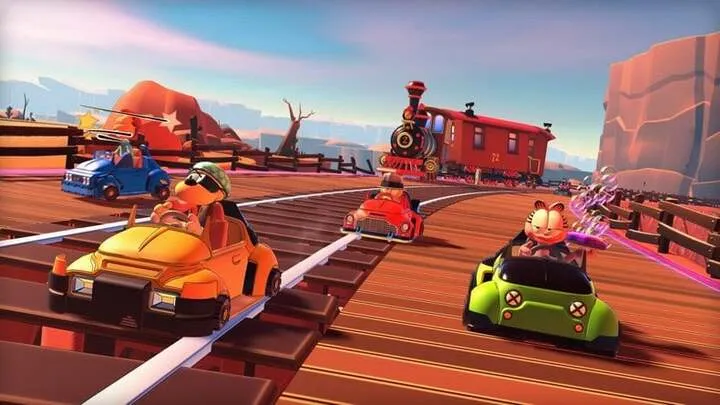
Occasionally, players will be hit by the "Monday Blues" debuff, which significantly increases tire friction and slows down the Sizzle Gauge. Navigating this requires "Friction Recovery" techniques. Instead of trying to maintain long drifts, you should switch to "Hop-Stuttering"—performing rapid, short jumps to minimize time spent in contact with the high-friction surface. This is a technical counter-play that allows you to maintain some momentum until the debuff wears off.
Once the debuff expires, you enter a "Recovery Window" where your friction is temporarily lower than normal. This is the optimal time to perform a "Mega-Slide." By linking multiple turns together during this window, you can actually gain back the time lost during the debuff phase. High-level play in Garfield Kart 2 is about mitigating these negative states and maximizing the "Tuesday Recovery" bonuses that follow.
7. Character and Kart Weight Classes: The Math of Rotational Inertia
Character choice in Garfield Kart 2 dictates your "Rotational Inertia." Heavy characters like Garfield and Jon have high inertia, meaning once they start a drift, they are very difficult to stop. This makes them excellent for long, high-speed tracks but poor for technical circuits. Light characters like Nermal and Squeak have low inertia, allowing them to snap into and out of drifts instantly, making them the kings of the "Kitchen Chaos" arena.
Weight Class Drift Profiles
- Heavy (Garfield, Jon): Low drift acceleration, High drift stability. Best for Red Boost sustainability.
- Medium (Arlene, Odie): Balanced stats. The most versatile for the "All You Can Drift" mode.
- Light (Nermal, Squeak): High drift acceleration, Low stability. Prone to "Spin-Outs" if they hit a wall during a slide.
Tuning your kart is equally important. Choosing "Slick Tires" over "Off-Road Treads" will decrease your baseline friction, making it easier to initiate a drift but harder to control the "Slide Angle." Most pro-tier players opt for a "Rear-Heavy" kart build, which pushes the center of gravity back and allows for a more aggressive "Bumper-Swing" during turns.
8. Environmental Hazards and Drift Interruption Logic
The environments in All You Can Drift are designed to disrupt your flow. Puddles of milk, scattered pizza boxes, and Jon’s vacuum cleaner all act as "Drift Breakers." If your tires hit an environmental hazard while you are sliding, the game’s engine immediately resets your Sizzle Gauge to zero. To avoid this, you must master the "Drift-Hop Over." This involves releasing the drift button just long enough to hop over the hazard and then re-initiating the slide before your wheels have a chance to straighten out.
In the "Farmhouse" biome, the mud sections provide a unique challenge. Mud creates "Sludge Friction," which doesn't break your drift but slows your speed to a crawl. The trick here is to "Hydro-Drift"—initiating a slide on a patch of grass and carrying the momentum into the mud. Since you are already in a slide state, the mud’s friction penalty is reduced by 40%, allowing you to "surf" over the difficult terrain while others get bogged down.
9. The Golden Lasagna: Mastering the Final Lap "Panic State"
In the final lap of a race, the game enters a "Panic State" where the music speeds up and the drift mechanics become even more sensitive. Your Sizzle Gauge fills 20% faster, but your "Burn Out" window becomes much narrower. This is where most races are won or lost. You must tighten your "Drift Tolerance," making smaller adjustments with the joystick to avoid over-heating your tires.
During this phase, the "Golden Lasagna" power-up becomes available for players in the middle of the pack. Activating this provides "Infinite Sizzle" for ten seconds. The mistake most players make is driving straight with the Golden Lasagna. Instead, you should be performing a "Continuous Snake," drifting back and forth across the track to stack as many mini-boosts as possible. Since the gauge never resets, you can essentially trigger a Tier 3 Red Boost every two seconds, creating a "Boost-Chain" that can catapult you from 5th to 1st place in the final stretch.
10. Advanced Telemetry: Analyzing Your "Drift Efficiency" Score
Post-race, the game provides a "Drift Efficiency" score. This is a complex calculation based on three factors:
- Total Slide Time: How much of the race was spent in a non-neutral state.
- Apex Precision: How close your kart’s center of mass was to the track’s designated apexes during a drift.
- Boost Conversion: The ratio of Tier 3 boosts to total boosts triggered.
To improve this score, you should record your gameplay and look for "Straight-Line Gaps." Every second you aren't drifting is a second you aren't building energy. The goal for world-record runners is a 95% Drift Efficiency, meaning they are only driving straight during the brief moments after a boost and before the next hop. Mastering this level of technical play transforms Garfield Kart 2 from a casual distraction into one of the most demanding racers on the market.
Conclusion
Garfield Kart 2 - All You Can Drift is a technical marvel disguised as a whimsical kart racer. Its deep reliance on thermal management, rotational inertia, and topographical physics creates a high-skill ceiling that rewards players for their dedication to the "Lasagna Friction" engine. By mastering the initiation phase, managing the Sizzle Gauge, and exploiting item synergies, you can turn any race into a masterclass in drifting. Remember: speed in this world is not about the engine; it’s about the slide. Keep your tires hot, your angles wide, and your lasagna crispy.